
March 26, 2026
Key Takeaways:
- Hidden Decay: Internal rot often goes unnoticed until a storm; look for fungal growth at the base as a primary indicator of “hollow” heartwood.
- The “V-Check”: Narrow, V-shaped crotches (co-dominant stems) are the #1 cause of split trunks in species like Bradford Pears and Maples.
- Ground Clues: Cracked soil or heaving turf on one side of a tree indicates the root plate is lifting – a sign of imminent failure.
- Hazardous Leans: A sudden lean is a “Code Red” emergency; trees that have grown at an angle over decades are generally safer than those that shifted overnight.
For homeowners in the rolling hills and suburban stretches of Davidson County, trees provide essential shade, privacy, and curb appeal. However, the same environment that helps them grow, with heavy spring rains and rich Middle Tennessee soils, can also mask structural instability. Because we face high-wind microbursts, heavy ice loads, and volatile weather patterns in the Nashville area, a tree that looks “fine” in the calm of summer may actually be structurally compromised.
Understanding the biology of a tree and the physics of how it stands is crucial. Knowing the physical signs of an unsafe tree can be the difference between a simple pruning job and a catastrophic insurance claim. In towns like Goodlettsville and Hendersonville, being proactive is the only way to stay ahead of the “falling hazard” curve.
Identifying the Structural “Point of Failure”
A tree is essentially a living engineering marvel, but like any structure, it has limits. When those limits are breached by rot, pests, or poor growth patterns, the tree becomes a liability.
1. Co-dominant Stems and Included Bark
When a tree has two or more main trunks of similar size growing from the same point, they compete for space. This is perhaps the most common structural defect found in Davidson County landscapes.
- The Danger: As these stems grow, bark gets trapped between them (including bark). This prevents the wood from bonding, essentially creating a “perforation” in the tree. Instead of a solid union, you have two heavyweights leaning away from each other.
- The Breaking Point: Many of our mature Silver Maples and Elms have this defect. During the “concrete snow” events typical of our winters, the weight of the ice acts as a wedge, splitting the tree clean down the center.
2. Deep Vertical Cracks and Cankers
A crack that extends through the bark and into the wood is a sign that the tree is literally pulling itself apart.
- Structural Splits: Deep cracks indicate that the tree’s structural integrity has already been breached. If you see two cracks occurring on opposite sides of the trunk, the tree is considered “high risk” for a total trunk failure.
- Cankers: These are localized areas of dead bark. While they may look like small wounds, they often hide deeper “honeycombing” or internal decay. Cankers on a main trunk significantly weaken the tree’s ability to withstand the torque generated by high winds.
3. Root Flare Decay and Fungal “Conks”
The root flare, where the trunk expands at the soil line, is the “foundation” of your tree.
- The Decay Sign: If you see mushrooms or shelf-like fungal “conks” growing at the base or on the trunk, the tree has internal rot. Fungus only grows on decaying organic matter; if it’s on your tree, the wood is being eaten from the inside out.
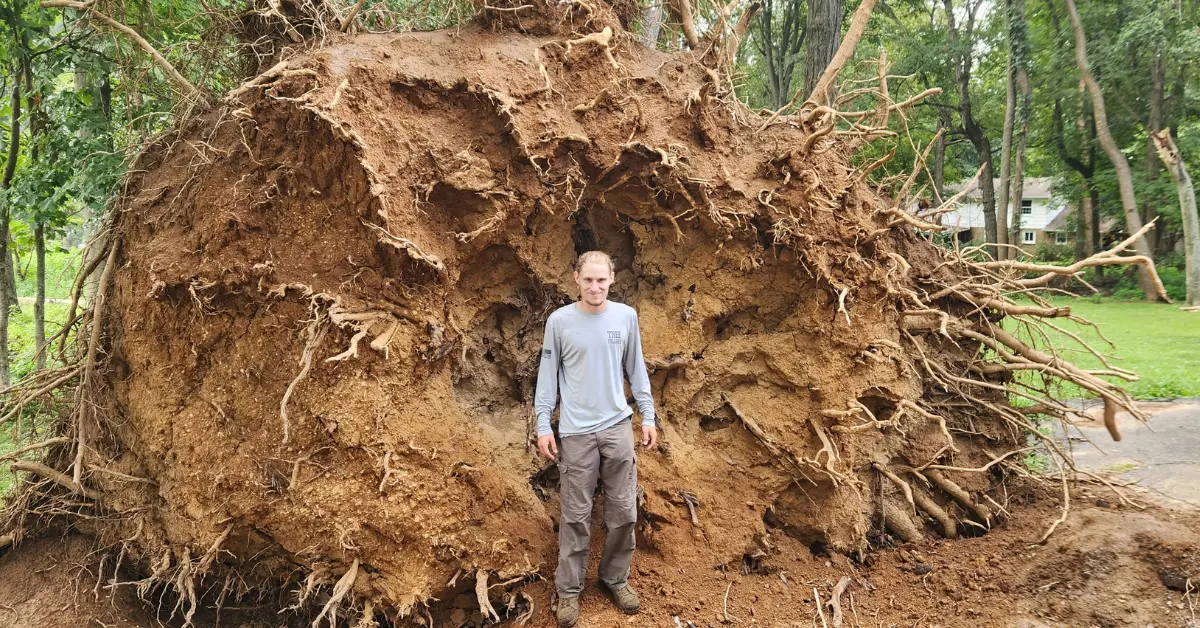
- The Risk: A tree with significant root rot may still have a green canopy because the outer layer (the cambium) is still transporting nutrients, but the internal “heartwood” that provides strength is gone. This leads to “root-plate failure,” where the entire tree tips over without warning.
Environmental Stressors Unique to Middle Tennessee
In areas like White House and Springfield, our unique soil and weather patterns accelerate tree failure in ways that other regions don’t experience.
Saturated Clay Soils: Many Davidson County properties sit on heavy, compacted clay. During our frequent wet springs, the soil becomes “plastic” and loses its grip on tree roots. If a tree is already leaning or has a compromised root system, a summer thunderstorm can easily cause the tree to uproot entirely.
The “Sail Effect”: A full, leafy canopy acts like a giant sail. In the Nashville area, summer microbursts can produce winds exceeding 60 mph. If a tree has internal decay or included bark, the torque from the wind will cause the tree to snap at its weakest point, often several feet up the trunk.
Treatment vs. Removal: Knowing the Difference
Not every structurally unsound tree needs to be cut down. Modern arboriculture offers ways to mitigate risk.
- Tree Cabling: If a high-value tree has co-dominant stems but is otherwise healthy, we can install high-strength steel cables. These limit the sway of the individual trunks, allowing them to support each other during a storm.
- Strategic Weight Reduction: By pruning the heavy, overextended limbs (especially those hanging over your roof), we can reduce the leverage on the trunk and roots.
- Hazardous Removal: If more than 30% of the trunk is hollow or the root plate is lifting, removal is the only safe option.
Identifying a hazard is only the first step; safely managing it requires expert intervention.
Tree Fellers provide comprehensive tree care and hazardous removal services across Nashville, Hendersonville, and Goodlettsville. When a tree exhibits these hazardous signs, the risks to your home and power lines are too high for a “wait and see” approach. Tree Fellers specialize in identifying these structural vulnerabilities and providing expert Tree Removal and Tree Cabling to secure your property. Our locally owned team understands the unique challenges of Tennessee landscapes, offering 24/7 emergency services and precision cutting that ensures dangerous trees are handled swiftly and safely before the next storm arrives.
Frequently Asked Questions
Can a tree with a large hollow in the trunk be saved?
It depends on the “shell thickness.” Generally, if at least one-third of the tree’s radius is sound wood, it may be stable. However, if the hollow is accompanied by a lean or is located near a high-traffic area (a “target”), removal is often the safest option. At Tree Fellers, we assess the “target zone” to determine the true risk level.
What is the difference between a “dead” tree and an “unsafe” tree?
A dead tree is always unsafe because the wood begins to dry out and become brittle immediately. However, a live, green tree can be “unsafe” if it has structural defects like included bark or root rot that compromise its stability. Many homeowners are surprised when a “perfectly green” tree falls; this is usually due to internal structural failure.
Does “Tree Cabling” actually work for Nashville storms?
Yes. Tree cabling and bracing involve installing high-strength steel hardware between co-dominant stems. This limits the “sway” of the trunks, reducing the leverage that causes splitting during high winds or ice loads. It is a highly effective way to preserve the life of a structurally flawed but otherwise healthy tree.
Should I be worried about a tree leaning over my house?
If the tree has always leaned that way (a natural lean), it has likely grown “anchor roots” to compensate. If the lean is new or if you see mounded soil on the side opposite the lean, the tree is in the process of falling and needs an emergency inspection immediately.
Are Bradford Pears more dangerous than other trees?
Statistically, in Middle Tennessee, yes. Due to their poor branching structure (narrow V-crotches) and brittle wood, they are the most frequent victims of storm damage. Many local HOAs now recommend their removal and replacement with sturdier native species like White Oaks or Maples.
Can I check for root rot myself?
You can look for “dieback” at the very top of the canopy (the crown). If the topmost branches are losing leaves or dying while the bottom is green, the roots are likely struggling to transport nutrients due to rot or soil compaction. You should also look for fungal growth near the soil line.
Is it safer to remove a hazardous tree in the winter?
Winter is often an ideal time for removal because the ground is firmer (protecting your yard from equipment ruts) and the lack of leaves makes it easier for arborists to see structural defects. It also allows us to manage heavy limbs safely without the added weight of foliage.
What happens to the wood after a hazardous removal?
We can haul all debris away, chip it on-site, or, if you prefer, cut the logs into manageable sizes for you to use as firewood. We prioritize a “No Leaf Left Behind” cleanup process.
Conclusion
Is your tree a pillar of strength or a looming hazard? In Davidson County, the signs of an unsafe tree are often written in the bark and roots, provided you know where to look. While a “wait and see” approach might work for some home maintenance projects, it is a dangerous strategy when dealing with multi-ton hardwoods near your bedroom or power lines.
The Emerald Ash Borer, heart rot, and poor branching patterns are active threats across our local landscape. Whether you are concerned about a new crack in your Silver Maple or want to stabilize a historic Oak through professional tree cabling, the experts at Tree Fellers are here to help.
Sources
- University of Tennessee Institute of Agriculture (UT Extension): Managing Trees for Safety and Health.
- Tennessee Department of Agriculture (Division of Forestry): Emerald Ash Borer and Forest Health Updates.
- International Society of Arboriculture (ISA): Best Management Practices for Tree Risk Assessment (TRAQ).
- National Weather Service (Nashville Office): Historical Storm Data for Middle Tennessee.
- USDA Forest Service: Urban Tree Risk Management: A Community Guide to Program Design and Implementation
- Tree Fellers Internal Case Data: 1,000+ Precision Removals and Emergency Storm Responses.